
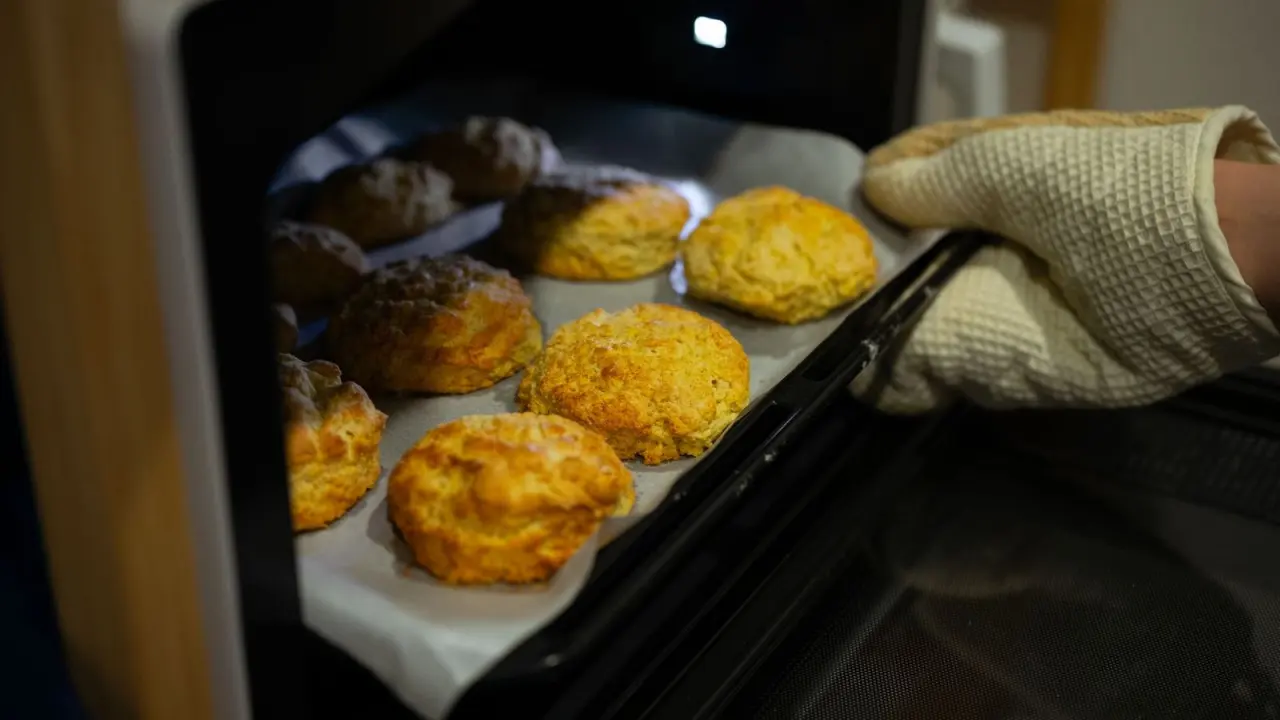
Your gluten-free cake sank or your cookies spread flat, and you suspect Centennial’s thin air. High altitude gluten free baking usually needs less leavening, less sugar and more liquid, adjusted one change at a time.
If you would rather skip the experiments for a day, our guide to gluten free bakeries Centennial CO is a good next stop.
| Item | Value |
|---|---|
| Elevation where recipe changes may start | 3,000 feet and higher |
| Air pressure at sea level | 14.7 psi |
| Air pressure at 5,000 feet | 12.3 psi |
| Baking powder, 3,500-6,500 feet | Reduce by 1/8 tsp per tsp in the recipe |
| Sugar, 3,500-6,500 feet | Reduce by 1 Tbsp per cup |
| Liquid, 3,500-6,500 feet | Increase by 1-2 Tbsp per cup |
These figures come from CSU Extension’s High Elevation Food Preparation Guide and an Ask Extension answer on cake baking. They can change, so check the sources before you rely on them.
Why thin air changes a gluten-free bake
Air pressure falls as you climb. CSU Extension puts the pressure at sea level at 14.7 psi and at 5,000 feet at 12.3 psi, so the blanket of air pressing on your batter is lighter.
That lighter blanket affects food in two major ways, according to the same CSU guide:
- Water and other liquids evaporate faster and boil at lower temperatures.
- Leavening gases in breads and cakes expand more quickly.
For a gluten-free batter, that means a cake can rise fast, then collapse before the structure sets. It can also dry out sooner than the recipe’s author planned.
CSU says recipes may need changes in time, temperature or ingredients from 3,000 feet and higher, as the Baking at Elevation page repeats. Look up your own kitchen’s elevation before you touch a recipe.
The oven itself is not the culprit in the same way. The CSU guide notes that oven temperatures are not affected by elevation, but that dry mountain air pulls moisture out of food faster during cooking. You can read that in the High Elevation Food Preparation Guide.
Starting adjustments by elevation band
An Ask Extension expert shared the starting points below in reply to a Colorado baker who planned to use a gluten-free chocolate cake mix. The expert called baking at high elevation a trial-and-error process, so treat every number as a first guess. The full answer is public.
| Elevation band | Baking powder | Sugar | Liquid |
|---|---|---|---|
| 3,500-6,500 feet | Reduce 1/8 tsp per tsp | Reduce 1 Tbsp per cup | Add 1-2 Tbsp per cup |
| 6,500-8,500 feet | Reduce 1/4 tsp per tsp | Reduce 2 Tbsp per cup | Add 2-4 Tbsp per cup |
| 8,500-10,000 feet | Reduce 1/4 tsp per tsp | Reduce 1-3 Tbsp per cup | Add 3-4 Tbsp per cup |
The table is adapted from the Ask Extension cake baking answer, which also suggests adding an extra egg white in every band. Figures can change, so check the source before you bake.
When a range is given, King Arthur Baking advises trying the smaller adjustment first. You can always go further on the next batch.
Moisture is the gluten-free sticking point
Another Ask Extension expert answered a question about gluten-free cupcakes at 7,500 feet. The reply said you will have to adjust the liquid at that elevation and that moisture retention will be an issue, as the Ask Extension answer explains.
The same expert said it is common to add an extra egg or some oil to help increase moisture. That is one lever to try after you have adjusted the liquid.
The idea matches CSU’s note that flours tend to be drier and absorb more liquid in high, dry climates. A batter that looked right at sea level can turn stiff and crumbly once it sits in dry air.
Cookies, quick breads and yeast doughs
CSU’s Baking at Elevation page is not written specifically for gluten-free recipes. Use its advice as a starting point and test it on your own flour blend.
- Cookies: many sea-level recipes are improved by slightly less baking powder or soda, slightly less fat or sugar, and slightly more liquid, flour or baking temperature.
- Quick breads and muffins: without adjustments, a bitter or alkaline flavor can result from baking soda or baking powder that is not fully neutralized, so slightly reduce these leaveners.
- Yeast doughs: use less yeast, let the dough rise in the refrigerator to slow it, and stop when it has just doubled.
Cake-like quick breads are more delicately balanced, so CSU suggests following its cake recommendations for them.
How to test changes without wasting a batch
Mountain kitchens vary a lot. King Arthur Baking notes that microclimates differ so much that what works for you may not work for a neighbor down the road, and that what works at 3,500 feet may not work at 6,500 feet.
A simple routine keeps the guesswork under control:
- Change one ingredient at a time so you can see what it did.
- Write down what you changed and how the bake turned out.
- Start with the smaller adjustment whenever a range is offered.
- Repeat until the crumb, rise and moisture suit you.
If you are new to all this, our guide to gluten free baking for beginners covers the basics that these adjustments build on. Once your recipe works, read how to prevent gluten cross contact in baking so a good loaf stays safe to eat.
Frequently asked questions
Do I need to change my oven temperature at altitude?
Show answer
The CSU guide says the oven behaves the same at any elevation, yet its cookie advice lists a slight rise in baking temperature as one possible tweak. Treat that as an experiment, not a rule.
Can I use a boxed gluten-free cake mix in the mountains?
Show answer
Colorado bakers have asked Extension this exact question about a King Arthur gluten-free chocolate cake mix. The answers pointed to reducing leavening and sugar, raising liquid and adding egg white, as shown in the Ask Extension reply.
Why do my cookies still spread flat?
Show answer
Many cookie recipes carry a lot of sugar and fat, which can make them sprawl even at low elevations, according to CSU Extension. Cold dough, parchment paper and room-temperature baking sheets can all limit the spread.
Will one set of adjustments work in every kitchen?
Show answer
Probably not. King Arthur Baking describes its charts as a starting point and says the process is as much art as science. Keep notes so each bake teaches you something.